

У цьому посібнику · 20 розділів
- In Nice itself
- The public beach by Castel Plage
- Coco Beach: rocks, ladders and a gay following
- Other beaches you may hear about
- Towards Monaco: Saint-Laurent d'Èze and Cap-d'Ail
- Saint-Laurent d'Èze
- Plage des Pissarelles, Cap-d'Ail
- The law, in short
- Season and timing
- Local colour
- Practical tips
- Pride and events
- A few words of French
- At a glance
- Frequently asked questions
- Is there a gay beach in Nice?
- Is Coco Beach in Nice a nudist beach?
- Where is the nearest gay naturist beach to Nice?
- How do I get to Saint-Laurent d'Èze from Nice?
- Is sex on a beach legal in France?
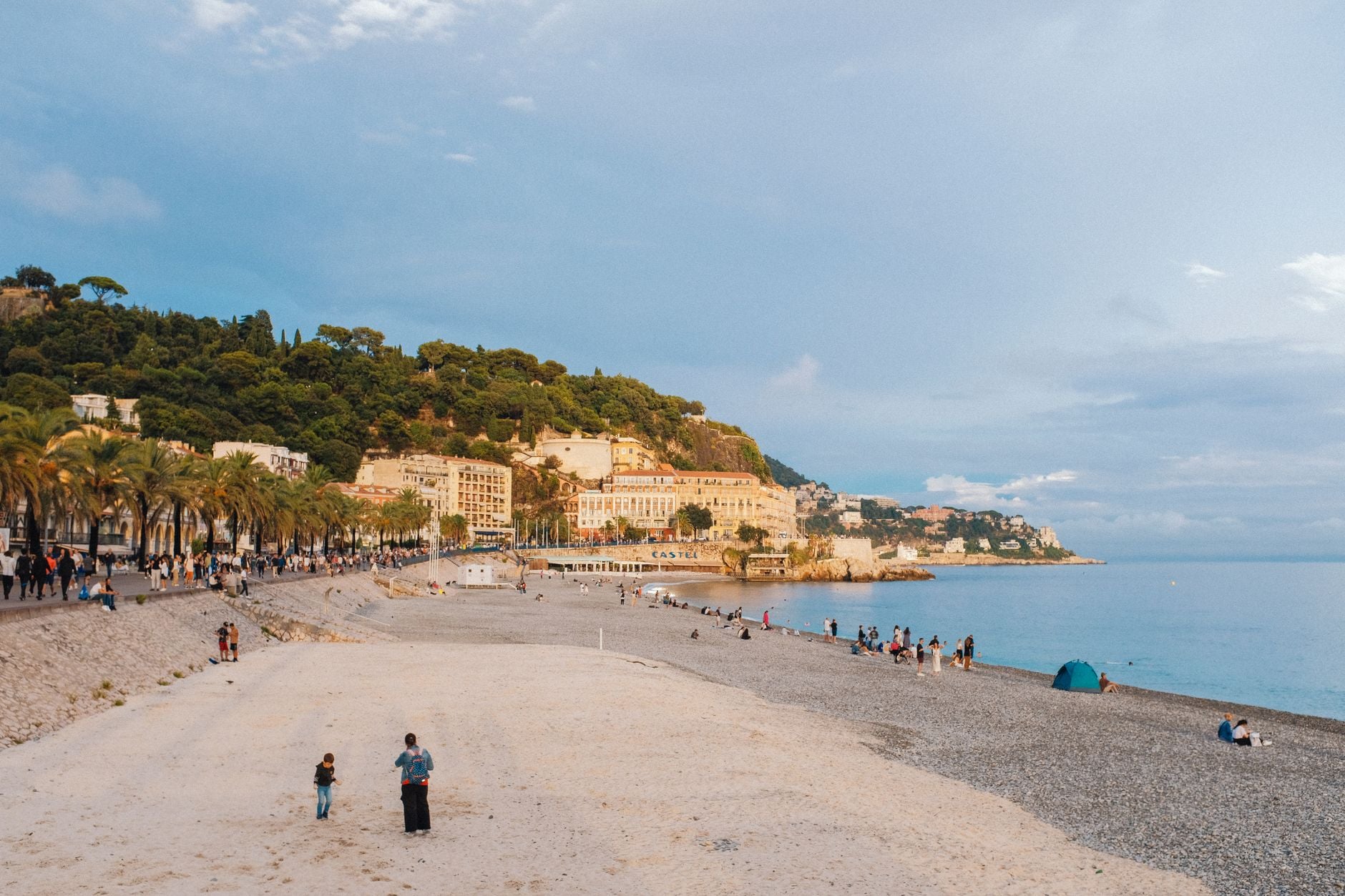
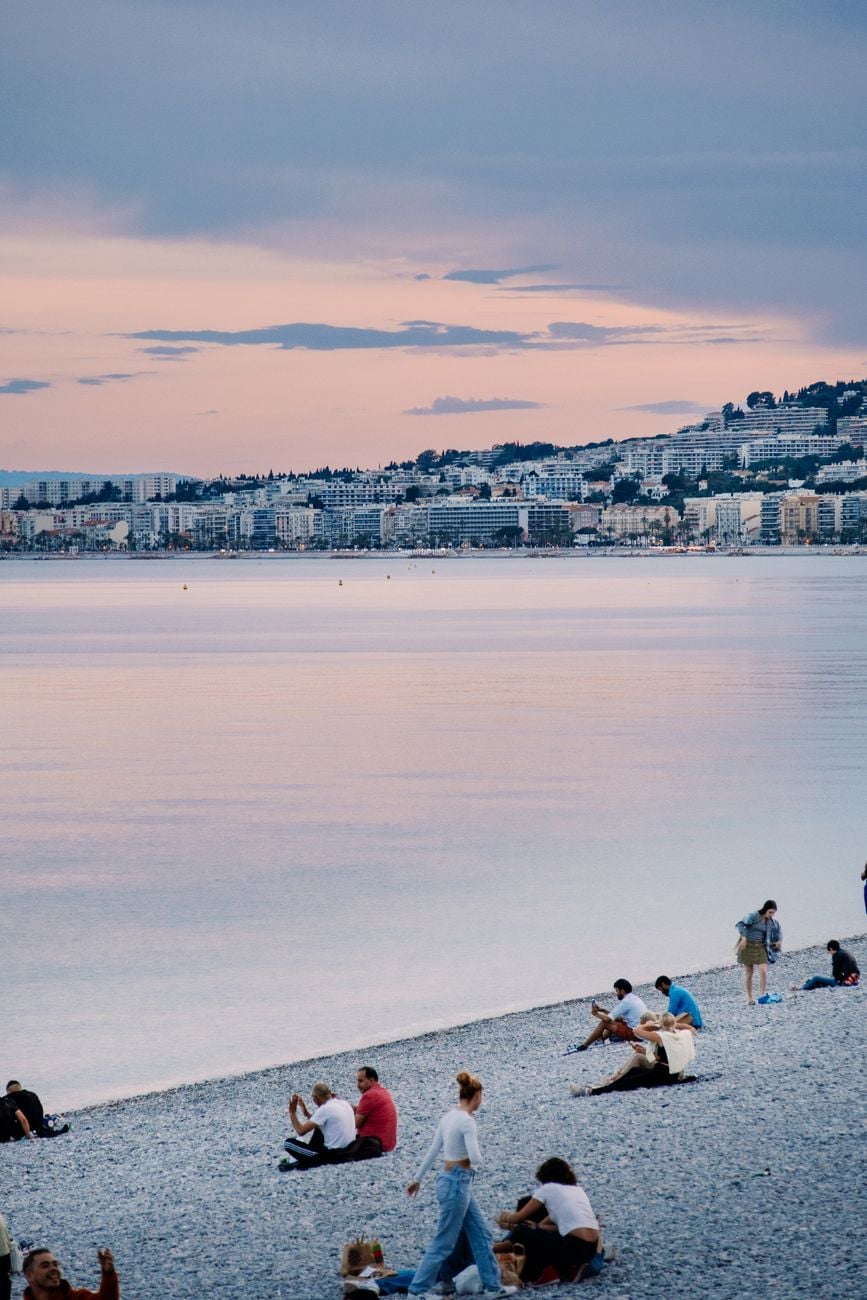
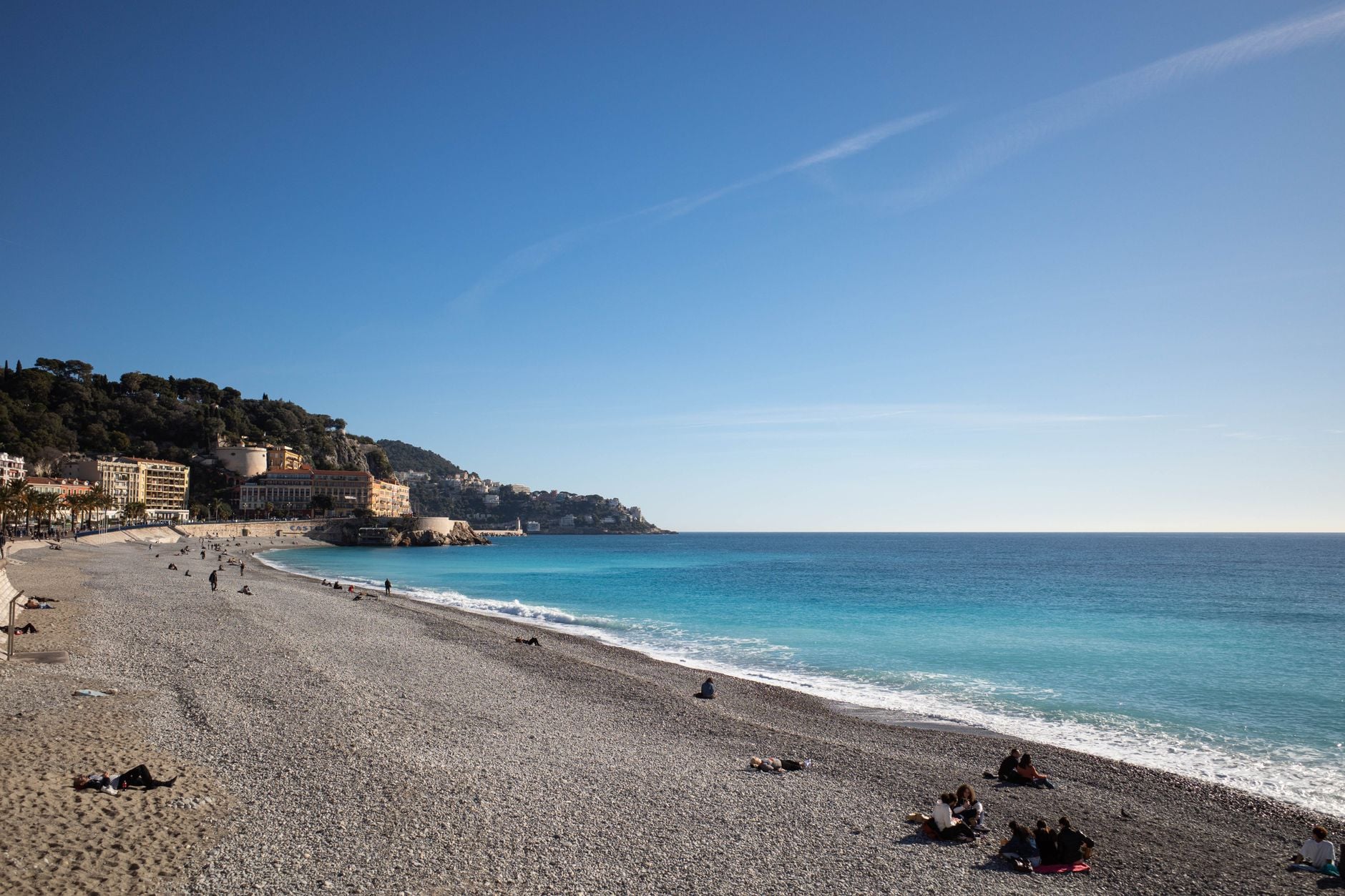
On the Baie des Anges the sea doesn't hiss over sand, it rattles: every wave drags the grey-blue pebbles down the slope and throws them back, a sound you hear all along the Promenade des Anglais. At the eastern end, where the promenade bends round Castle Hill, the ochre walls of Vieux-Nice drop almost straight into the water, and past the port the coast turns to pale rock and pine. Nice has no official gay beach. What it has is habit: a stretch of public pebbles by Castel Plage that LGBTQ+ locals have used for decades, the rock platforms of Coco Beach east of the port, and, a short train or bus ride towards Monaco, the gay naturist coves of Saint-Laurent d'Èze.
Legal in one line: France decriminalised sex between men in 1791 and opened marriage and adoption to same-sex couples in 2013. Same-sex couples on Nice's beaches are unremarkable, but nudity is allowed only where naturism is authorised, and sex in any place open to public view is a criminal offence.
In Nice itself
The public beach by Castel Plage
Where: Quai des États-Unis, at the eastern end of the seafront below Castle Hill (the Colline du Château), just before the promenade turns towards the port. It's an easy walk from Place Masséna through or along Vieux-Nice.
What it is: a pebble beach split, as everywhere in Nice, between a public section and a private concession. Castel Plage, the private beach, has a bar, a restaurant, paid loungers and parasols and decking down to the water; Travel Gay calls it "always popular with the gay crowd", and a September 2026 French guide notes that it carries the city's Nice Rainbow Côte d'Azur label. The free public pebbles next to it are the part that has long been cited as a meeting point for the LGBTQ+ community. Don't expect a gay-only beach: Travel Gay reviewers have described it as very gay on a Saturday afternoon, and also as busy with families. If you want a lounger, ring Castel Plage on +33 4 93 85 22 66 to check prices and book.
Know before you go: the pebbles are large and the beach shelves steeply into deep water, so bring water shoes and a mat or padded towel. Nothing on the public section is for hire; the nearest lifeguard post in 2026 was at the Ponchettes beach next door. Sauna du Château is a few minutes' walk away on Rue des Ponchettes, and the bars of Vieux-Nice are just inland.

Coco Beach: rocks, ladders and a gay following
Where: east of the port, on the coastal path towards the Cap de Nice, reached on foot from the port via Boulevard Carnot and Avenue Jean Lorrain. Travel Gay gives 2 Avenue Jean Lorrain.
What it is: no sand and no pebbles, only flat limestone platforms with steps cut into the rock and ladders into the sea. The water is clear and deep straight away. It faces west, so you get strong afternoon sun and the sunset over the bay, but no shade. A September 2026 French guide says Coco Beach has had a reputation for years as a place gay men like, with a mixed crowd, and France's official tourism site lists it among the country's gay-friendly beaches.
Not a naturist beach. Some gay guides still describe Coco Beach as a nudist hangout. It isn't: local sources state that naturism is not permitted, and one notes reports of checks. Keep your swimwear on.
Facilities: a fresh-water shower and a tap; no toilets, loungers, food or drink. The nearest restaurants are back towards town. Dogs are not allowed. Space on the rocks is limited, so come early in summer.
Getting there by bus: the nearest stop is Théodore de Banville/Lorrain; a beach guide lists it on Lignes d'Azur line 98 from the centre, with a change needed on the way back. Routes change, so check the Lignes d'Azur app before you set off.
Other beaches you may hear about
- Plage des Ponchettes: the public pebble beach right in front of Vieux-Nice, a short walk from the Cours Saleya. It's a central, busy city beach with a lifeguard post (staffed until 13 September in 2026), not a gay beach as such, though it sits next to the Castel stretch.
- La Réserve: small rocky access points to the sea east of the port, near Coco Beach. They are not recognised gay beaches, and rocky entries need extra care when there's a swell.
- Plage de la Plateforme: a quieter rock platform further along the coastal path, on the border with Villefranche-sur-Mer, with ladders and no facilities. A naturist directory notes that nudity there is not authorised, so the same rule applies as at Coco Beach.
- Bus: the regional line 600 (Nice–Monaco–Menton, the former line 100, run by ZOU!) leaves from Square Normandie-Niemen in Nice and runs along the coast through Villefranche, Beaulieu, Èze-sur-Mer and Cap-d'Ail. In February 2026 buses ran every 10 to 15 minutes on weekdays and every 20 minutes at weekends, at €2.10 by contactless card or €2.50 in cash. Travel Gay says to get off at Parking St Laurent d'Eze and follow the signposted "Castelleret Inférieur" trail. Buses get very full on summer weekends.
- Train: TER trains from Nice-Ville to Èze-sur-Mer take about 15 minutes, roughly every 30 minutes. From the station you still have to continue east along the Basse Corniche to the Saint-Laurent parking, so the bus drops you closer.
- Car: from Èze-sur-Mer take the M6098 towards Monaco; about 650 m after the tunnel there's roadside parking on the right by a snack van, where the path starts. Spaces are limited.
- Rocks: at Coco Beach, La Réserve and Saint-Laurent the water is deep right at the edge and the rock is uneven and slippery. Use the ladders, check the swell before you swim, and stay out when a west wind is pushing waves onto the platforms. Don't dive where you can't see the bottom.
- Pebbles: Nice's city beaches shelve steeply. In summer the city fixes access ropes on ten beaches to help people climb out of the water; elsewhere you're on your own, so water shoes help.
- Theft: bags left on the pebbles while you swim are an easy target. Bring only what you need, take turns swimming if you're with a friend, or pay for a lounger at a private beach, which Travel Gay notes gives more protection from pickpockets. On the secluded paths at Saint-Laurent, leave valuables at home, keep your phone charged and head back up well before dark.
- Emergencies: call 112.
- Trams in town: Lignes d'Azur runs three tram lines. Line 2 links the airport with the centre and the port (Port Lympia), handy for the walk to Coco Beach; Line 1 crosses Place Masséna, the best start for Castel. Check the current single fare before you travel.
- Night home from Èze: the line 601 night bus runs between Menton and Square Normandie-Niemen in Nice, nightly in summer from 21 June and on Thursday to Saturday nights the rest of the year.
- Cards and cash: line 600 takes contactless cards on board. There's nothing to buy at Coco Beach or Saint-Laurent beyond a snack van at the top of the path, so bring cash or supplies.
- Apps: Grindr is the main gay app on the Riviera.
- Water shoes: Nice's beaches are made of big, smooth pebbles that roll and slide underfoot, and the beach drops off steeply, so you're out of your depth a few steps from the edge. Water shoes (chaussures d'eau) make getting in and out much easier and safer, and they also help on the slippery rock at Coco Beach and Saint-Laurent.
- Health: the sun on white rock is fierce and there's no shade at Coco Beach. Bring more water than you think you need.
- After the beach: see the Nice saunas guide for Les Bains-Douches and Sauna du Château, and the Nice city guide for bars.
- La plage – the beach. Les galets – the pebbles. Les rochers – the rocks.
- Plage naturiste – naturist beach. Naturisme interdit – naturism prohibited.
- Un transat – a sunlounger. Un parasol – a sunshade.
- Chaussures d'eau – water shoes.
- Le maître-nageur – the lifeguard. Baignade surveillée – lifeguarded swimming.
- Le sentier – the path. L'arrêt de bus – the bus stop.
- Au secours ! – help!
- Socca and pan bagnat – the two beach snacks of Nice.
Towards Monaco: Saint-Laurent d'Èze and Cap-d'Ail
Saint-Laurent d'Èze
Steep path, no step-free access. The only way down from the coast road is a steep stepped path through the trees: about 10 minutes down, and the climb back up is the hard part. Reaching the further coves means crossing rocks. It is not suitable for wheelchairs, pushchairs or anyone with limited mobility. Wear shoes with grip, carry water, and don't attempt it in the dark or when the steps are wet.
Where: on the Basse Corniche (the coast road, M6098) between Èze-sur-Mer and Cap-d'Ail, about 13 km east of Nice. France's official tourism site says it "welcomes a predominantly gay crowd in a stunning natural setting", and gay guides have cited it for years as the Riviera's gay naturist beach.
What it is: a narrow, mostly pebbly beach in a pine wood, with a small stream running down to the sea. The main beach is a public beach; gay guides place the naturist area in the coves at the eastern end, towards Cap Estel, a few hundred metres further along. A French beach guide warns that the path to the further coves is steep with many rocks to cross. There are no facilities, so bring water, food and shoes you can scramble in.
Is naturism official here? We couldn't find a municipal decree for Saint-Laurent itself. French naturist directories list the neighbouring Plage des Pissarelles, about 200 m away on the Cap-d'Ail side, as the official naturist beach, and note that the two are often confused. France's tourism site calls Cap-d'Ail "the closest authorized nudist spot to Nice". Look for signs on the ground and stay within the naturist coves.
Cruising: misterb&b also lists the beach as a gay cruising spot (lieu de drague). The beach, coves and paths are all public places open to view: nudity where tolerated is one thing, sex in view of others is a criminal offence (see the law box below). Isolated corners also carry a higher risk of theft.
Getting there:
Plage des Pissarelles, Cap-d'Ail
A wild beach bordered by rocks, reached only by a small path from the Basse Corniche, and listed by naturist directories as the authorised naturist beach on this stretch. It's a naturist beach rather than a gay one, but it's next door to Saint-Laurent and the same bus serves both. Access is described as difficult; Cap-d'Ail's tourist office (04 93 78 02 33) can tell you about current access. France's tourism site also mentions a naturist section at Èze-sur-Mer extending towards the rocky coves; follow the signs there too.
The law, in short
Article 222-32 of the French Penal Code (exhibition sexuelle) punishes sexual exhibition imposed on others in a place open to public view with up to one year in prison and a €15,000 fine, and more if a minor under 15 is involved. Since 2021 the offence covers an explicit sexual act, real or simulated, even without nudity. Beaches, coves, paths and car parks are all places open to public view, naturist ones included. Nudity is accepted only where naturism is authorised; elsewhere, including Coco Beach, keep your swimwear on.
Rocks, sea and your things.
Season and timing
Summer is the high season and the busiest time on every beach above, especially weekends in July and August. In 2026 the city's lifeguards were on duty from 1 July to 31 August, 09:00 to 18:30, at 11 of Nice's beaches, with several posts staying open until 13 September. Since 2024 all of Nice's beaches are smoke-free. Outside July and August the beaches are quieter, there are no lifeguards, and the rocky spots depend even more on the state of the sea.
Local colour
The Niçois beach day runs on a simple kit: a padded mat for the pebbles, a towel and something from the old town. Before the beach, pick up a paper cone of socca, the thin chickpea-flour pancake cut into strips and dusted with black pepper, eaten hot from the oven. In Vieux-Nice, Chez Thérésa, trading since 1925 according to the Côte d'Azur tourist board, sells it from a small stand on the Cours Saleya market and at 28 Rue Droite, a few minutes from Castel; in the port quarter, Chez Pipo is on the way to Coco Beach. For later, take a pan bagnat, the round bread stuffed with tuna, egg, olives and raw vegetables. When the sun drops, the apéro is a glass of chilled Provençal rosé or a pastis on a terrace facing the Baie des Anges, before the bars of Vieux-Nice fill up.
Practical tips
Pride and events
Pink Parade 2026: Nice's Pride march, organised by the association Aglaé, took place on Saturday 11 July 2026 under the motto "The future will be queer". It left the Port of Nice at 15:30, ran along the quays and the Promenade des Anglais past the Castel stretch, and ended at the Théâtre de Verdure with the Pink Party. The 2027 date had not been announced as of October 2026; recent editions have fallen on a Saturday in July, right in beach season.
Lou Queernaval: during the Nice Carnival in February, the city hosts what is billed as France's first LGBTQIA+ carnival. The 11th edition took place on 27 February 2026 at Place Masséna.
A few words of French
At a glance
| Beach | Where | Type | Surface | Getting there | Note |
|---|---|---|---|---|---|
| Public beach by Castel Plage | Quai des États-Unis, below Castle Hill | Gay-popular, mixed, clothed | Large pebbles | Walk from Place Masséna (tram Line 1) | Private Castel Plage next door: loungers, bar, restaurant |
| Coco Beach | East of the port, Avenue Jean Lorrain | Gay-popular, mixed, clothed; naturism not permitted | Flat rock, ladders | Walk from the port; bus stop Théodore de Banville/Lorrain | Deep water, no shade, shower only |
| Saint-Laurent d'Èze | Basse Corniche, between Èze-sur-Mer and Cap-d'Ail | Gay naturist coves at the eastern end | Pebbles and rock | Bus 600 or TER to Èze-sur-Mer, then 10-minute path | No facilities; steep stepped path, no step-free access |
| Plage des Pissarelles | Cap-d'Ail, next to Saint-Laurent | Naturist (listed as official) | Rock-bordered | Bus 600; small path from the Basse Corniche | Difficult access |
Frequently asked questions
Is there a gay beach in Nice?
Not officially. The two gay-popular spots in town are the public pebbles beside Castel Plage, below Castle Hill, and the rock platforms of Coco Beach east of the port. Both are mixed and clothed.
Is Coco Beach in Nice a nudist beach?
No. Naturism isn't permitted there and local sources report checks, so swimwear stays on. For authorised naturism, head east to Cap-d'Ail.
Where is the nearest gay naturist beach to Nice?
Saint-Laurent d'Èze, about 13 km east on the coast road towards Monaco, is the one gay guides cite, with naturists in its eastern coves. The officially listed naturist beach is Plage des Pissarelles next door, in Cap-d'Ail.
How do I get to Saint-Laurent d'Èze from Nice?
Bus 600 towards Monaco from Square Normandie-Niemen stops at Saint-Laurent d'Èze; the TER to Èze-sur-Mer is quicker but leaves you a walk along the coast road. The last stretch is a steep stepped path of about 10 minutes, not suitable for anyone with limited mobility.
Is sex on a beach legal in France?
No. Sexual exhibition in public view is an offence under article 222-32 of the Penal Code, punishable by up to a year in prison and a €15,000 fine. Naturist beaches are no exception.
Part of the GayOut beaches series. See the full gay Nice guide for bars, saunas, hotels and events.