


У цьому посібнику · 19 розділів
- What the 2024 law says and how it's used
- The political situation in 2026
- Incidents in Batumi and Adjara
- Going out: no scene, but a resort
- Apps, phones and your data
- What to enjoy in Batumi
- Adjarian food and drink
- Where to stay
- Practical tips
- Pride and community
- Want an open LGBTQ+ scene? Go here instead
- A few words of Georgian
- At a glance
- Frequently asked questions
- Is it legal to be gay in Georgia?
- Are there gay bars in Batumi?
- Is there a Pride in Batumi?
- Is it safe to use Grindr or other dating apps in Batumi?
- Is Batumi more relaxed than Tbilisi for LGBTQ+ travellers?
Read this first: this is a Safety Mode guide. Sex between men is legal in Georgia, but since December 2024 a "family values" law has banned the "promotion" of same-sex relationships, Pride-style gatherings and much more, and the country has been in a political crisis since late 2024. Batumi has no openly LGBTQ+ bar, club or party night that we could verify in 2025 or 2026, and we don't name "gay-friendly" places here, because doing so could put their owners and guests at risk. We never list cruising places in Georgia. Keep a low profile and read the safety sections before you go out.
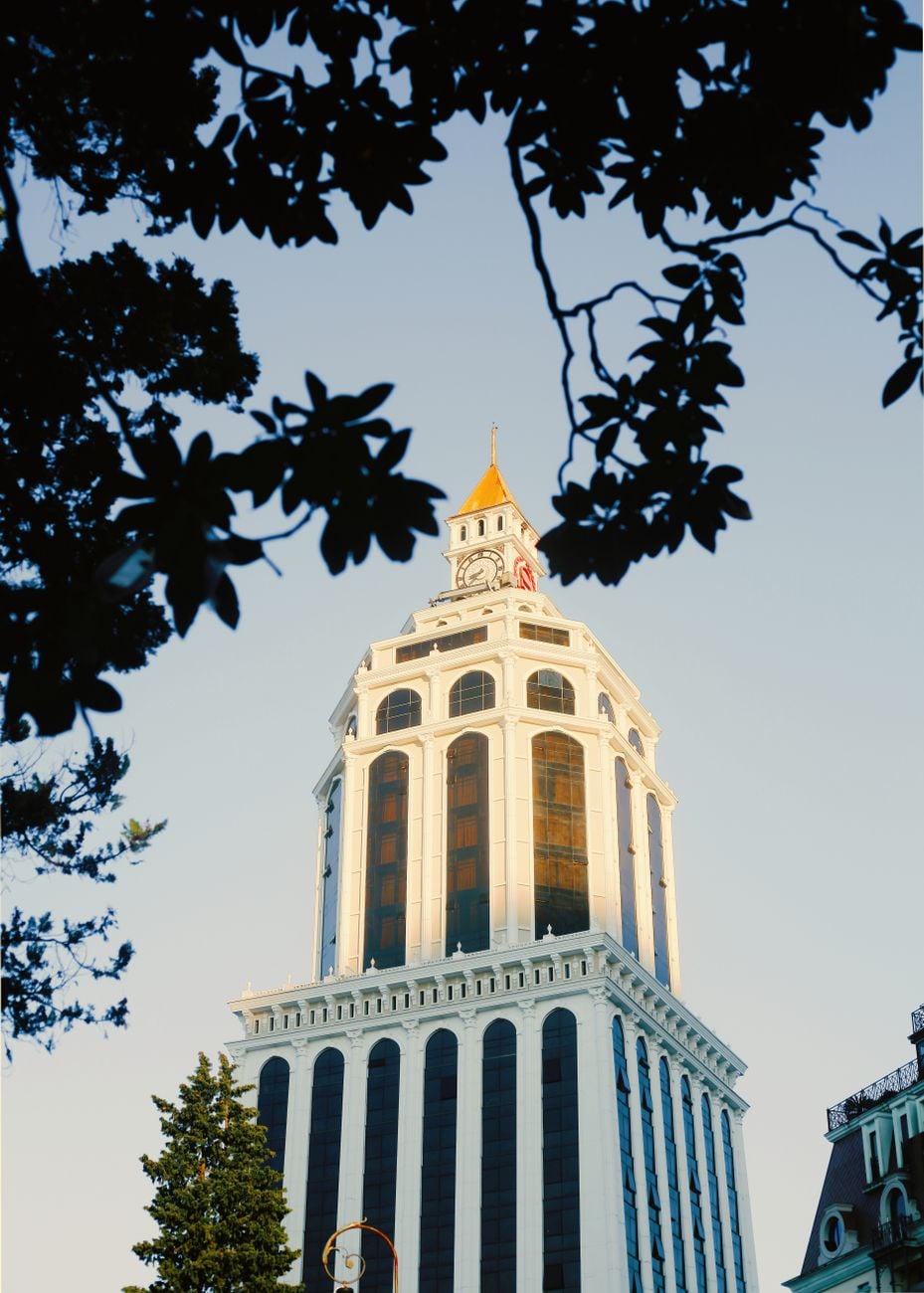
Batumi smells of salt, wet palms and charcoal grills. The seafront Boulevard runs for kilometres past fountains, cycle paths and pebble beaches, the 145-metre Alphabetic Tower glitters at dusk, and two steel lovers, Ali and Nino, glide towards each other and apart again by the water. Behind them, the restored 19th-century streets of Old Batumi fill with cafés, casino lights flash along the shore, and the humid subtropical air brings sudden, heavy rain. It's Georgia's summer resort and the capital of Adjara, an autonomous republic where both the Orthodox majority and the large Muslim community are socially conservative. A busy beach town is not an open one: there is no gay scene here, and the same restrictive national laws apply. Georgia's real queer nightlife, small as it is, exists only in the capital; see our gay Tbilisi guide. Come to Batumi for the sea, the food and the garden, and keep your private life private.
Legal in one line: sex between men has been legal since 2000 (age of consent 16), but the constitution has defined marriage as a union of a woman and a man since 2018, and the Law on Family Values and Protection of Minors, in force since December 2024, bans the "promotion" of same-sex relationships and gender identity in education, broadcasting and advertising, restricts gatherings that promote them, outlaws gender-affirming medical care and legal gender change, and bars LGBTQ+ people from adopting.
Emergency contacts – save these before you travel
- Emergency number: 112 for police, ambulance and fire. Canada's travel advice notes that the 112 Georgia app can connect you with emergency services in English.
- United States: US Embassy Tbilisi, 29 Georgian-American Friendship Avenue, Didi Dighomi; +995 32 227 7724, after hours +995 32 227 7000 (travel.state.gov, ge.usembassy.gov).
- United Kingdom: the Foreign Office in London answers 24 hours a day on +44 20 7008 5000. The British Embassy is in Tbilisi; check its current contacts on gov.uk before you go.
- Canada: the Consulate of Canada in Tbilisi, +995 32 298 2072 in office hours; outside them, Global Affairs Canada's Emergency Watch and Response Centre in Ottawa (travel.gc.ca).
- LGBTQ+ support: Equality Movement has given legal and psycho-social help to LGBTQ+ people in Georgia, including victims of violence and blackmail. Contact it through its official website from a safe device.
- If you're detained: ask for your embassy to be told and for a lawyer, don't sign anything you don't understand, and don't unlock your phone voluntarily.
- bans recognition of any "alternative" union other than marriage between a man and a woman;
- bars adoption and fostering by people who are not heterosexual or do not identify with their sex at birth;
- bans gender-affirming medical procedures and the recording of a changed gender in documents;
- restricts the "promotion" of same-sex relationships and gender identity in schools, in the media and in advertising;
- restricts public gatherings and demonstrations that promote them;
- makes 17 May, the international day against homophobia, a holiday honouring "family and parents".
- August 2026: on 9 August, a presenter at Adjara TV, the region's public broadcaster, was assaulted in Batumi, and a second man allegedly threatened to stab him. In a video he posted, a man points at his dyed blond hair and uses a homophobic slur. The Interior Ministry announced two arrests on 11 August for violence and threats. The presenter said he faced similar harassment almost every evening, and a journalists' ethics body called for an urgent investigation. Civil Georgia later reported that the presenter had himself been detained over "insulting police officers" and "petty hooliganism".
- Dating apps: Grindr and other apps are used in Georgia, but Equality Movement reported several attacks in 2024 that followed the same pattern: a meeting set up on a dating app, after which unknown people turned up and beat or abused the victim. One victim was a foreign national, and most victims didn't go to the police. In a resort full of short-stay visitors, you know even less about who is on the other end. Meet first in a busy public place, never go to a private address or get into a stranger's car, and tell a friend where you are.
- Blackmail and outing: Equality Movement also describes blackmail through the spreading of personal information and forced outing. If someone threatens you, stop contact, keep screenshots and call your embassy before paying anything.
- Your phone: before you travel, remove intimate photos from the phone and any synced album, turn off lock-screen previews and use a strong passcode.
- Social media: don't post LGBTQ+ content tagged in Georgia while you're there, and switch off location sharing on apps.
- The Boulevard: the long palm-lined seafront promenade, with fountains, art installations and a cycle path. Walk it at sunset, when locals come out and the Alphabetic Tower, a 145-metre tower celebrating the Georgian script, lights up.
- Ali and Nino: Tamara Kvesitadze's moving metal sculpture of two lovers, installed on the seafront in 2010. The tall, see-through figures slide slowly towards each other, meet, pass through one another and drift apart again. Stay for a full cycle, ideally after dark when they are lit.
- Old Batumi: the historic borough of restored 19th-century buildings, with Europe Square and the Italian-style Piazza, ringed by cafés and busy in the evening.
- The Botanical Garden: about 9 km north of the city at Mtsvane Kontskhi, the "Green Cape", founded by the Russian botanist Andrei Krasnov and officially opened in 1912. It spreads over more than 100 hectares of steep green cliff above the Black Sea, with bamboo groves, magnolias, camellias and terraces where the paths open onto the water below. Bus 10 runs there from the centre and the airport.
- Casinos: gambling is a large part of the local economy, and the casinos draw many visitors from Turkey, where gambling is illegal. They are mainstream places with security staff; play only what you can lose.
- Gonio and the coast south: the Roman-era fortress of Gonio is about 15 km from the city, and the village of Sarpi sits on the Turkish border with forested hills behind. Batumi is about 20 km north of the border, so a day across into Turkey is possible; Turkey has its own rules and risks for LGBTQ+ visitors.
- The weather: Batumi is the wettest city in Georgia, with more than 2,400 mm of rain a year. Pack a light waterproof even in summer.
- Adjaruli khachapuri: the region's own version of Georgia's cheese bread, a boat-shaped loaf filled with bubbling melted cheese, brought to the table with a raw egg yolk and a knob of butter on top. Stir the yolk and butter into the hot cheese until it turns glossy, then tear off the crisp crust edges and dip them in.
- Borano: a rich Adjarian dish of cheese melted in butter, eaten with bread. One portion goes a long way.
- Sinori and achma: two more Adjarian cheese dishes. Sinori is made from thin dough and cottage cheese; ask for achma at bakeries and family restaurants.
- From the sea: small fried khamsa (Black Sea anchovy) with lemon, plus mussels and red mullet in seaside restaurants.
- Khinkali: pleated dumplings full of spiced meat and broth. Hold one by its twisted knob (kudi), bite a small hole, sip the broth, eat the rest and leave the knob on the plate.
- Wine and chacha: Adjara, like the rest of Georgia, makes wine in buried clay qvevri. Finish with a small glass of chacha, the grape brandy, carefully.
- Entry: citizens of the EU, the UK, the US and many other countries can usually visit Georgia without a visa for up to a year. Check the current entry rules, including any insurance requirement, with your government before travelling.
- Train from Tbilisi: modern Stadler trains run from Tbilisi Central to Batumi Central in about 5 hours 12 minutes, with two departures a day year-round and extra trains in summer, stopping at Kutaisi International Airport on the way. Book on the Georgian Railways site or Tkt.ge; summer seats sell out early. Batumi Central station is about 4 km from the Old Town and the Boulevard, so take a city bus or a Bolt from there.
- By road: marshrutkas (minibuses) leave from Didube in Tbilisi and take about six to seven hours; coaches leave from Ortachala. The train is the more comfortable option.
- From the airport: Batumi International Airport is about 7 km from the centre. Bus 10 runs from early morning until late evening through the centre to the Botanical Garden, taking about 20 minutes to town. At night, or with heavy bags, use Bolt.
- Taxis: Bolt works in Batumi and shows the fare in the app before you ride, which avoids haggling with street drivers. It is also the safer way home late at night.
- City buses: pay by tapping a contactless card. TBC Bank cards and Tbilisi travel cards don't work on Batumi transport, and foreign cards may be charged a little more.
- Money: the currency is the Georgian lari (GEL). Cards are widely accepted on the seafront; carry some cash for markets and small cafés.
- Health: bring enough of any medication you use, including PrEP. If you need PEP after a risk, start it within 72 hours: go to a hospital emergency department, or to Tbilisi's national AIDS Centre (the Infectious Diseases, AIDS and Clinical Immunology Research Center) if you can get there in time.
- 17 May: now the official day of "family and parents", it has long been marked by church processions. Keep a low profile that day.
- Regions to avoid: the US, UK and Canada all advise against travel to the Russian-occupied regions of Abkhazia and South Ossetia, Under Georgia's Law on Occupied Territories, foreigners may enter Abkhazia only from the Zugdidi direction, on the Georgian-controlled side; entering from any other direction, including from Russia, is a criminal offence in Georgia. Abkhazia lies further up the same coast, so don't be tempted by a "day trip".
- Travel advice: the US currently rates Georgia at Level 1 (exercise normal precautions) apart from the occupied regions, but its LGBTQI+ section describes the 2024 law and attacks on gay and lesbian people. Read the US, UK or Canadian advice before you go.
- Gamarjoba (გამარჯობა) – hello
- Madloba (მადლობა) – thank you
- Ki / ara (კი / არა) – yes / no
- Bodishi (ბოდიში) – sorry, excuse me
- Ra ghirs? (რა ღირს?) – how much is it?
- Zghva (ზღვა) – sea
- Gaumarjos! (გაუმარჯოს!) – cheers! (literally "victory to…")
- Gemrielia (გემრიელია) – it's delicious
- Nakhvamdis (ნახვამდის) – goodbye
All embassies are in Tbilisi, a five-hour train ride away, so keep their numbers on paper as well as on your phone.
What the 2024 law says and how it's used
The Law on Family Values and Protection of Minors was introduced by the ruling Georgian Dream party in June 2024 and passed its third reading on 17 September 2024 by 84 votes to 0, with the opposition boycotting. President Salome Zourabichvili refused to sign it, and the Speaker of Parliament signed it into law on 3 October 2024. It took effect at the start of December 2024. The package changed 18 other laws. Among other things it:
In 2025 Parliament went further: "gender identity" was removed from the anti-discrimination law and from the hate-crime grounds, and the gender equality law was rewritten. ILGA-Europe also reports that in April 2025 the far-right group "Protect Your Homeland" asked Parliament to ban LGBTI marches and rainbow clothing at public gatherings, and that a committee was assigned to study the request. The Council of Europe's Committee of Ministers urged Georgia to repeal the 2024 law.
The law's biggest effect has been to end public LGBTQ+ life: no Pride, cancelled health and trans-care programmes and organisations working under pressure. We found few published reports of it being used against individual visitors, but Canada's travel advice still warns that LGBTQ+ people may face discrimination and possible charges under it. Assume that anything that looks like "promotion" in public, such as a rainbow flag, a Pride T-shirt or a social media post tagged in Batumi, can get you into trouble.
The political situation in 2026
Georgia has been in a deep political crisis since the disputed parliamentary election of October 2024. When Prime Minister Irakli Kobakhidze announced in November 2024 that the government was shelving EU accession talks until 2028, protests began in Tbilisi and spread to other cities, Batumi among them. Rights groups documented homophobic abuse by police and special forces during the November and December 2024 crackdown.
Batumi became a symbol of that crisis. On 11–12 January 2025, during a protest in the city, Mzia Amaghlobeli, founder of the Batumi newspaper Batumelebi and the news site Netgazeti, was arrested after slapping the head of the Batumi city police. On 6 August 2025 she was convicted on a reduced charge and sentenced to two years in prison, a sentence upheld on appeal in November 2025. In October 2025 the European Parliament awarded her the Sakharov Prize, which she shared with the jailed Belarusian journalist Andrzej Poczobut.
The legal squeeze on civil society has continued. In April 2025 Parliament passed a Foreign Agents Registration Act, which can carry up to five years in prison, and a grants law requiring government approval for foreign funding; in March 2026 the grants rules were widened and breaches made a criminal offence. Protest rules have also hardened: since October 2025, wearing a face mask at a protest can bring 15 days' administrative detention for a first offence, and blocking a road is now a criminal offence. On 6 March 2026 the European Commission suspended visa-free Schengen travel for holders of Georgian diplomatic, service and official passports for 12 months, citing the crackdown on protesters, opposition politicians and independent media.
Stay away from protests. Canada warns that foreigners who join demonstrations in Georgia may face fines, detention, deportation or problems re-entering the country, and the UK says demonstrations have led to violent clashes and that tensions can escalate without warning. If you see a crowd gathering in central Batumi, walk the other way, and don't film the police.

Incidents in Batumi and Adjara
We found no other specific, published reports of attacks on LGBTQ+ people in Batumi in 2025–26. That reflects how few cases get reported rather than how safe the city is: ILGA-Europe notes that bias crimes in Georgia are widely under-reported because of low trust in the police. Batumi also has a large Muslim community alongside its Orthodox majority, and both are socially conservative.
Going out: no scene, but a resort
We found no openly LGBTQ+ bar, club or regular queer night in Batumi active in 2025 or 2026, and no Georgian LGBTQ+ organisation lists one. In summer the seafront fills with beach bars, restaurants and loud clubs aimed at a mainstream holiday crowd. Treat them as exactly that: mixed, straight-majority places where same-sex affection can attract attention or worse. If you want queer nightlife, the small scene of Success Bar and Bassiani's Horoom nights is in Tbilisi; see our gay Tbilisi guide.
Getting home safely. The UK Foreign Office warns about strangers who approach visitors to take them to a restaurant or nightclub, and about drink spiking: buy your own drinks and keep them in sight. Georgia's drug laws are very harsh, with the UK warning of prison sentences of 5 to 25 years. Don't kiss or hold hands in the street on the way out, and leave by app taxi, such as Bolt, rather than walking along the dark end of the beach.

Apps, phones and your data
What to enjoy in Batumi

Adjarian food and drink
Where to stay
Large international and chain hotels on or near the seafront are the easiest choice for couples: book a double, state your bed preference in advance and you shouldn't need to explain. Small family guesthouses may be less relaxed about two men sharing a bed. See the hotels we list in Batumi, and read recent reviews before booking.

Practical tips
Pride and community
There has never been a Pride in Batumi, and there is no public Pride anywhere in Georgia. The Tbilisi Pride organisation, founded in 2019, held no physical Pride events in 2024 after the 2023 attack on its festival. ILGA-Europe reports that it largely suspended its activities in 2025, closed its office and relocated staff, saying it could not hold Pride Week safely. We found no public Pride event in Georgia in 2026. If you want to support local LGBTQ+ people, follow and donate to Georgian organisations such as Equality Movement and WISG (Women's Initiatives Supporting Group) through their official channels.
Want an open LGBTQ+ scene? Go here instead
If you'd rather travel without looking over your shoulder, Greece has had same-sex marriage since 2024 and open scenes in Athens and Thessaloniki.
A few words of Georgian
Georgian has its own beautiful, curling alphabet and no relation to Russian. Many older people also speak Russian, many visitors come from neighbouring Turkey, and younger people often speak English.
At a glance
| Place | Type | Where | Note |
|---|---|---|---|
| Batumi Boulevard | Seafront promenade | Along the whole city shore | Best at sunset; mainstream crowds |
| Ali and Nino | Moving sculpture | Seafront, near the Alphabetic Tower | Installed 2010 |
| Old Batumi and Piazza | Historic quarter, cafés | City centre | Restored 19th-century streets |
| Batumi Botanical Garden | Garden | Mtsvane Kontskhi, about 9 km north | Opened 1912; bus 10 |
| Gonio Fortress | Roman-era fort | About 15 km south | Half-day trip |
| Batumi Central station | Train station | About 4 km from the centre | Trains to Tbilisi, about 5 hours |
| Batumi International Airport | Airport | About 7 km from the centre | Bus 10 or Bolt |
Frequently asked questions
Is it legal to be gay in Georgia?
Yes. Sex between men has been legal since 2000, with an age of consent of 16. But a law in force since December 2024 bans the "promotion" of same-sex relationships, Pride-style gatherings, gender-affirming care and adoption by LGBTQ+ people, so discretion is wise.
Are there gay bars in Batumi?
No. Batumi's beach bars and clubs are mainstream, and none is an LGBTQ+ venue. For queer nightlife, go to Tbilisi, about five hours away by train.
Is there a Pride in Batumi?
No. Batumi has never held one, and the 2024 law restricts gatherings that promote same-sex relationships. There was no public Pride anywhere in Georgia in 2026 either.
Is it safe to use Grindr or other dating apps in Batumi?
Use them with care. Equality Movement reported several attacks in Georgia in 2024 that began with meetings arranged on dating apps, including one on a foreign visitor. Make the first meeting a busy café, avoid private addresses and let a friend know your plans.
Is Batumi more relaxed than Tbilisi for LGBTQ+ travellers?
No. The same national laws apply, Adjara is conservative, and in August 2026 two men were arrested after an attack on a TV presenter in Batumi in which a homophobic slur was used. Keep the same low profile as in Tbilisi.
Part of the GayOut city guides. See the full gay Tbilisi guide for Georgia's small queer scene and the Georgia country page for the national overview. This guide is general information, not legal advice; laws and their enforcement can change quickly.
