




本指南 · 18 章節
- Wartime procedures: alerts, shelters, curfew and power
- Getting there (and out)
- The law in 2026
- Going out: Libertin, and an early night
- Libertin · Rishelievska Street 60
- Apps and personal safety
- Odesa Pride and community events
- A day in Odesa, the careful way
- Food, wine and Odesa humour
- Where to stay
- A few words of Ukrainian (and Odesa Russian)
- At a glance
- Frequently asked questions
- Is it safe to visit Odesa now?
- What time is the curfew in Odesa?
- How do you get to Odesa without flights?
- Are there gay bars in Odesa?
- When is Odesa Pride?
Read this first: Odesa is a city at war. Russia's full-scale invasion continues, and Odesa, its port and the roads around it are hit again and again by drones and missiles. In December 2025 a drone struck a car on the bridge near Mayaky, on the main road towards Moldova, killing a woman; in February 2026 an overnight drone strike on the port killed one person; and in September 2026 a jet-powered drone hit an administrative building in the city centre, followed by a second strike while rescuers were at work. Port infrastructure, granaries and warehouses are regular targets. The UK Foreign Office advises against all travel to every region outside a short list in the west, and the Odesa region is not on that list. The US State Department's advisory is Level 4: Do Not Travel for all of Ukraine. Travelling against official advice can invalidate your insurance. This page is for people who are in Odesa already, or who have a reason to be there: volunteers, journalists, family visits, work. Follow official advice and the instructions of the Ukrainian authorities above anything you read here.
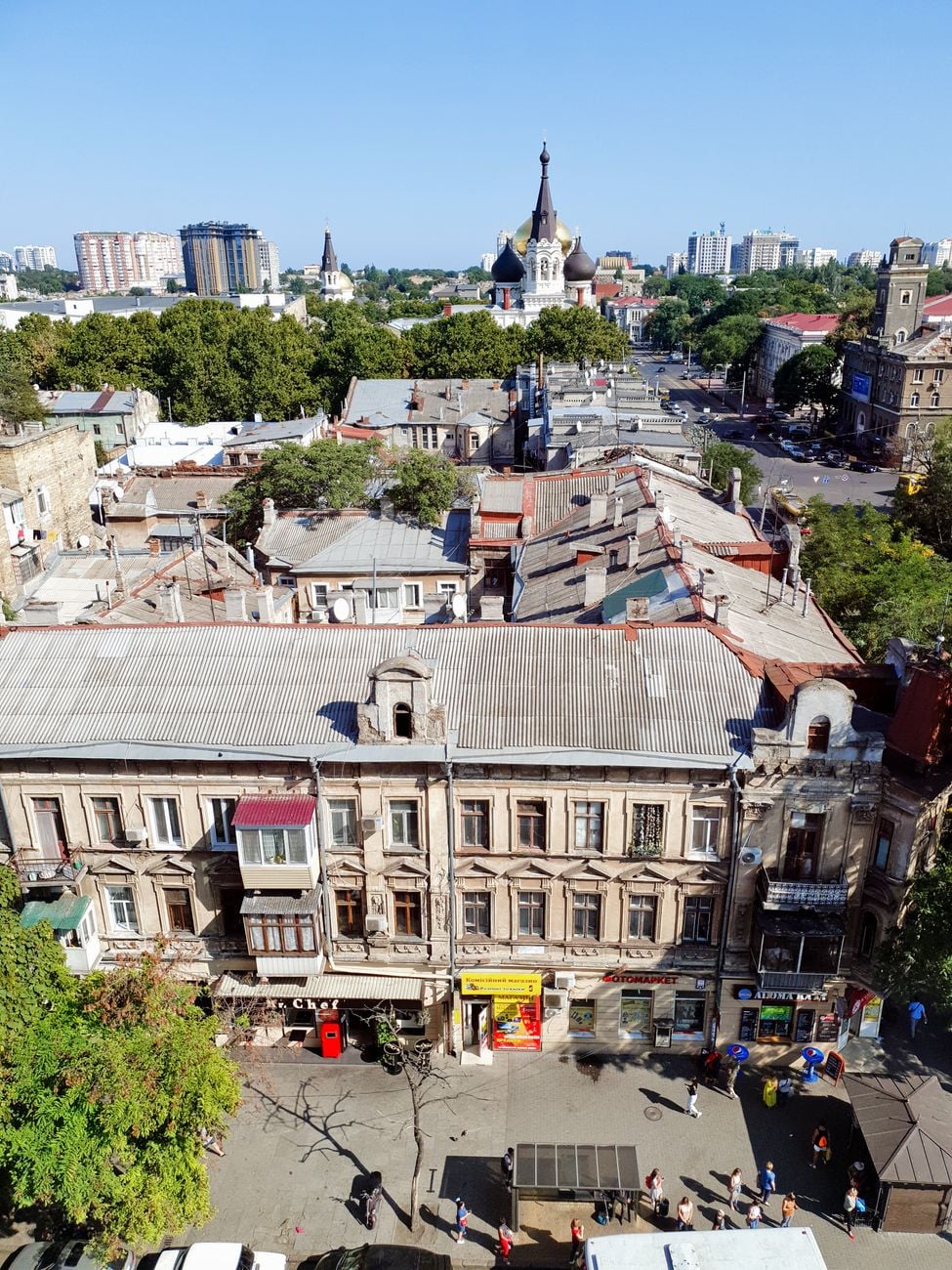
Odesa smells of the Black Sea and of acacia in spring. Trams rattle down a street grid laid out two centuries ago, the plane trees on Prymorskyi Boulevard lean towards the water, and at Privoz market the fishmongers still shout over trays of silver gobies. Odesans joke about everything, the war included, often to the drone of a generator during a power cut. Then, around 23:00, the city empties fast: the curfew is coming. Gay life here was small before 2022 and is smaller now: one dedicated club we could confirm, Libertin, an early evening rather than a late night, dating apps, and an LGBTQ+ community that marched in public again in May 2026 for the first time since the full-scale invasion. Odesa is cosmopolitan, Russian-speaking in much of daily life and more relaxed than many Ukrainian cities, but organised opposition turns up whenever queer people become visible.
Legal in one line: same-sex relations have been legal in Ukraine since 1991, but there is no recognition of same-sex couples. A civil partnership bill (No. 9103) has not been considered by parliament, and a new draft Civil Code (bill No. 15150), which passed its first reading in late April 2026, does not include partnerships; LGBTQ+ groups warn that some of its provisions would set rights back. At our last check neither had become law. Martial law is in force nationwide.
Wartime procedures: alerts, shelters, curfew and power
Keep this box handy. It gathers what you need to stay safe day to day.
- Before you arrive: install an air-raid alert app; the UK government has listed Air Alert (Повітряна тривога) among the options. Charge a power bank, pack a torch, download offline maps and carry some cash in hryvnia, as card terminals and ATMs can fail when the power does. Keep your passport with you at all times.
- When you check in: find the shelter nearest to your hotel and to anywhere you plan to spend an evening. Look for signs reading Укриття (shelter), and ask staff where theirs is. In Odesa, a room below the top floor and away from large windows facing the sea or the port is a sensible choice.
- When the siren sounds: go to a shelter and stay until the all-clear (Відбій); falling debris from interceptions is dangerous too. Strikes on Odesa often come at night. During an alert you may go to the nearest shelter even in curfew hours.
- Every evening: at our last check the curfew ran every night from 00:00 to 05:00 in Odesa and across the Odesa region, with no exceptions for weekends, holidays or the summer season. This schedule has been in place since 1 March 2023 (it started at 23:00 before that); a later 01:00 start was discussed in January 2026 but not adopted. During curfew you may not be on streets, beaches, parks or embankments without a pass. Public transport stops at around 23:30–23:45, cafés and bars usually close at about 22:30–23:00, and taxis run until the last moment. Times can change: check local news when you arrive.
- In a blackout: attacks on the grid mean power cuts. Since January 2026 you may go to the nearest "resilience point" (пункт незламності, punkt nezlamnosti) for warmth and charging during a blackout without an extra pass, if you can show the need.
- At all times, under martial law: follow the instructions of police and soldiers, and don't photograph or film military sites, checkpoints, the port, air defence at work or the aftermath of strikes. This is not a formality: Ukraine's security service said in October 2026 that 75 people had been sentenced since the start of the year for sharing photos and videos that revealed troop positions, air defence or the results of Russian strikes, under article 114-2 of the Criminal Code, which carries three to eight years in prison. Ukrainian men of military age, including dual nationals, may face exit restrictions and mobilisation checks.
Getting there (and out)
There are no civilian flights: Ukrainian airspace has been closed since February 2022, so you arrive and leave overland. From Odesa the nearest borders lie to the south-west.
The routes out are targets too. Bridges, roads and border crossings in the Odesa region are hit by Russian drones, and a crossing can close within hours.
- The Mayaky bridge: in mid-December 2025 drones struck the bridge on the Odesa–Reni highway near Mayaky, on the way to Moldova. A woman was killed, two checkpoints on the Moldovan border were temporarily closed, Moldova's border police urged people to avoid the area, and the road reopened in both directions only on 21 December.
- The Moldovan border: in August 2026 drone strikes forced the Tabaki checkpoint to suspend operations (21 August), and Vinohradivka–Vulcănești closed after its infrastructure was damaged (25 August).
- Orlivka, the ferry to Romania: on 1 September 2026 Shahed-type drones hit the crossing's building and grounds, starting fires, and processing of people and vehicles was suspended. Ukraine's border guards say the crossing has been attacked more than once.
- What to do: check the crossing's status just before you leave, have a second route ready (the train via Chișinău is one), keep your phone charged and some cash on you, and don't stop or take photos at bridges and checkpoints.
- Via Moldova by train: Ukrzaliznytsia (Ukrainian Railways) runs trains between Odesa and Chișinău. In December 2025, after the Mayaky bridge strike blocked the road towards Moldova, it added extra carriages to these services. Book through Ukrzaliznytsia's own app or website; seats sell out.
- Via Moldova by bus: buses between Odesa and Chișinău cross at Palanca (Mayaky–Udobne on the Ukrainian side), a trip usually listed at four to six hours. The road runs along the Dniester estuary and has been hit: after the December 2025 strike, traffic towards the western border crossings of the region stopped and people were directed to crossings in the Vinnytsia and Chernivtsi regions. Palanca was also closed to buses in severe weather in February 2026.
- Via Romania: the Orlivka–Isaccea car ferry crosses the Danube to Romania; see the box above for the September 2026 strike.
- From Poland: Ukrainian trains connect with Polish services at Przemyśl and Chełm. Reaching Odesa from there is a long overland journey; check Ukrzaliznytsia's app for current through-trains or connections, and book well ahead.
- Before you set off: use only official crossings (those between Ukraine and Transnistria are closed), check live status with Ukraine's State Border Guard Service and the Moldovan, Romanian or Polish border authorities, read your own government's advice for every country you pass through, and plan how you would leave at short notice.

The law in 2026
- Legal since 1991: sex between men and between women is legal.
- No partnerships: the Constitution defines marriage as a union of a woman and a man, and constitutional amendments are barred under martial law. The civil partnership bill (No. 9103) has not been considered; in April 2025 the parliament's Speaker said partnerships were not a priority. Ukraine's EU accession roadmap includes a civil partnership bill for 2025–2026, but human rights monitors consider adoption on that timetable unlikely.
- The draft Civil Code (No. 15150): it passed its first reading in late April 2026. LGBTQ+ groups object in particular to the vague concept of доброзвичайність ("public morality"), which they say could be used to restrict rights. The Odesa Pride march in May 2026 took place against the backdrop of this debate. At our last check the code had not been adopted.
- Work: since 2015 the Labour Code has banned discrimination at work on grounds that include sexual orientation and gender identity.
- Hate crimes: the Criminal Code still does not name sexual orientation or gender identity as hate-crime motives, and a bill to change that had not passed at our last check. Since September 2025 an order of the Prosecutor General requires police to record anti-LGBTQ+ bias motives.
- Monitoring: Nash Svit Center (gay.org.ua) recorded 60 anti-LGBTQ+ cases across Ukraine in 2025 in its national monitoring report. Its report for the first half of 2026 noted better cooperation between Odesa's authorities, police and Pride organisers. If something happens to you, Nash Svit is one of the places to report it.
Going out: Libertin, and an early night

Libertin · Rishelievska Street 60
Libertin is the one dedicated gay club we could confirm in Odesa in 2025–2026: a small night club and karaoke bar in the old centre. Local listings call it "a non-standard night club with bright parties", and its programme has included drag shows, karaoke and themed party nights, in one compact room with a mostly local, mostly male crowd. Reviews from 2025 are mixed: praise for the shows and the music, complaints about door policy and a cover charge (one reviewer mentioned 300 UAH), so dress a notch up.
- When: no fixed hours. Because of the curfew the club has moved its hours earlier, and they change at short notice. Plan an evening that ends well before midnight.
- Check first: Instagram @libertin_club or libertin-club.com, on the day.
- During an alert: ask staff on arrival where the nearest shelter is.
For more detail, see our guide to gay bars in Odesa.
If an older guide sends you somewhere else: Odesa once had a small cluster of gay bars and party nights, but small venues in Ukraine open, pause and close often under martial law, curfew and power cuts. Check recent reviews or social media before you go, and don't walk to an unfamiliar address late at night.
Apps and personal safety
- Apps: the usual gay dating apps work in Ukraine and are how most locals meet. The US State Department notes that gay and lesbian travellers in Ukraine have been targets of harassment, threats and violence. Meet first in a busy public place, tell a friend where you're going, and never agree to go to an unfamiliar address late in the evening, especially with curfew approaching.
- Discretion: holding hands in the centre may draw looks; read the street. Groups describing themselves as defenders of "traditional values" have counter-protested Pride here, most recently in May 2026.
- Photos: don't post pictures that show other people's faces at queer events without asking, and be careful with geotags, both for their safety and because images of strike sites and the port are off limits.
- Getting home: leave early enough to be indoors before midnight. A taxi booked through an app or by your hotel is easier than hailing one, and drivers want to be home before curfew too.
- Support: Gay Alliance Ukraine, which organised the 2026 Pride march, and LGBT Association LIGA are reported to work in Odesa.

Odesa Pride and community events
Odesa's Pride has a rough history. In August 2015 a district administrative court banned a planned Equality March after a lawsuit from the City Council's executive committee. In August 2016 more than 50 people marched from the Duke de Richelieu monument to Dumska Square by the city hall, with police buses blocking part of Prymorskyi Boulevard; the march itself passed without incident, but clashes broke out afterwards.
On Sunday 17 May 2026, the International Day Against Homophobia, Biphobia and Transphobia, Odesa held its first Pride march since the full-scale invasion, on Birzhova Square opposite the City Council. Anna Leonova of Gay Alliance Ukraine said the participants stood for equality, a law against hate crimes and legal recognition of civil partnerships. About half an hour before the start, a group calling itself "Unknown Patriots", joined by the "For Traditional Values" movement, gathered on the same square to oppose the march; its organiser said the counter-protest had been agreed with the police and was peaceful. Other civic initiatives held parallel actions in the city the same day. At our last check no date had been announced for 2027; watch Gay Alliance Ukraine's channels, and follow organisers' safety instructions if you take part.
A day in Odesa, the careful way
In wartime, see Odesa by day. The historic centre was inscribed on UNESCO's World Heritage List in January 2023 by emergency procedure, and placed at the same time on its List of World Heritage in Danger; strikes have since damaged buildings in the centre, so expect boarded windows and sandbagged monuments.
- The Potemkin Stairs: the long granite flight that runs from the Duke de Richelieu monument at the top of Prymorskyi Boulevard down towards the port, famous from Eisenstein's Battleship Potemkin. Don't photograph port facilities from the stairs.
- The old centre: walk from the Opera and Ballet Theatre along Prymorskyi Boulevard and down Deribasivska Street, then through the courtyards of the streets around it. Find a shelter on your route before you set off.
- Privoz market: the big, loud food market near the railway station, the place for smoked fish, cheese, pickles and the sharpest Odesa banter. Keep an eye on your phone in the crowds.
- Beaches: under martial law, only beaches approved by the regional authorities and the Defence Council open for the season, and only if they have lifeguards, rescue boats, an alert system, a marked swimming zone and a shelter nearby. In 2025 about 32 beaches opened across the Odesa region, and the governor expected at least 36 in 2026. Swim only on a beach officially opened that season, leave when the siren sounds, and remember that beaches are off limits during curfew. By late autumn the season is over.

Food, wine and Odesa humour
Odesa cooking draws on the many communities of an old port city. Order forshmak, the city's chopped-herring spread on dark bread; a plate of fried bychky (little Black Sea gobies); aubergine "caviar"; and a glass of wine from the Odesa region. Eat early, as kitchens close well before curfew.
Odesa likes to call itself the capital of humour. Humorina, its 1 April festival, has been a city ritual since 1973; in 2026 the day was kept as one of mourning after a deadly Russian attack. The jokes in the cafés and at Privoz have not stopped, and an Odesan answering a question with a question is a local art form rather than rudeness.
Where to stay
Most visitors stay in the old centre, within walking distance of Libertin and the sights. In wartime, ask before you book whether the hotel has its own shelter or a basement, a generator and a plan for power cuts, and check recent reviews.

A few words of Ukrainian (and Odesa Russian)
Ukrainian is the state language; in Odesa you will also hear a great deal of Russian, with its own local flavour. Ukrainian is always a safe choice.
- Добрий день (dobryi den') – hello. Дякую (dyakuyu) – thank you. Будь ласка (bud' laska) – please / you're welcome.
- Будьмо! (bud'mo) – cheers!
- Форшмак (forshmak) – herring spread. Бички (bychky) – gobies. Привоз (Pryvoz) – the market.
- Повітряна тривога (povitriana tryvoha) – air-raid alert. Відбій (vidbii) – all-clear.
- Укриття (ukryttia) – shelter. Комендантська година (komendantska hodyna) – curfew.
At a glance
| Place | Type | Where | When | Note |
|---|---|---|---|---|
| Libertin | Gay club & karaoke bar | Rishelievska Street 60 | Evenings; hours shifted by curfew | Drag, karaoke; check Instagram first |
| Odesa Pride | Pride march | 2026: Birzhova Square, opposite the City Council | Around 17 May; 2026 edition 17 May | Counter-protest on site; 2027 TBA |
| Historic centre & Potemkin Stairs | UNESCO World Heritage (in danger) | Prymorskyi Boulevard, Deribasivska Street | Daytime | Know your nearest shelter |
| Privoz market | Food market | Near the railway station | Daytime | Fish, cheese, local banter |
Frequently asked questions
Is it safe to visit Odesa now?
No. Both the UK and US governments tell travellers not to go: the UK covers the Odesa region in its advice against all travel, and the US puts all of Ukraine at Level 4. Drones and missiles still hit the city, so anyone there needs an alert app and a shelter nearby.
What time is the curfew in Odesa?
At our last check, from midnight to 05:00 every night across Odesa and the Odesa region, with no weekend or holiday exceptions. Public transport stops at around 23:30, so plan to be indoors well before midnight.
How do you get to Odesa without flights?
Overland only, because Ukrainian airspace is closed: by train or bus from Chișinău in Moldova, by ferry from Romania, or by rail from Poland. Drones have hit the Mayaky bridge and border crossings in the region, so check live border and rail information just before you set off.
Are there gay bars in Odesa?
Yes, one we could confirm: Libertin, a small gay club and karaoke bar on Rishelievska Street with drag shows and themed nights. Its hours have moved earlier because of the curfew, so check its Instagram on the day.
When is Odesa Pride?
Usually around 17 May, the International Day Against Homophobia, Biphobia and Transphobia. The 2026 march, the first since the full-scale invasion, took place on that date on Birzhova Square, with a counter-protest nearby. No 2027 date had been announced at our last check.
Part of the GayOut city guides. See also the gay Odesa bars guide and our gay Lviv guide. This guide is general information, not legal or security advice; in wartime, conditions can change within hours.
