

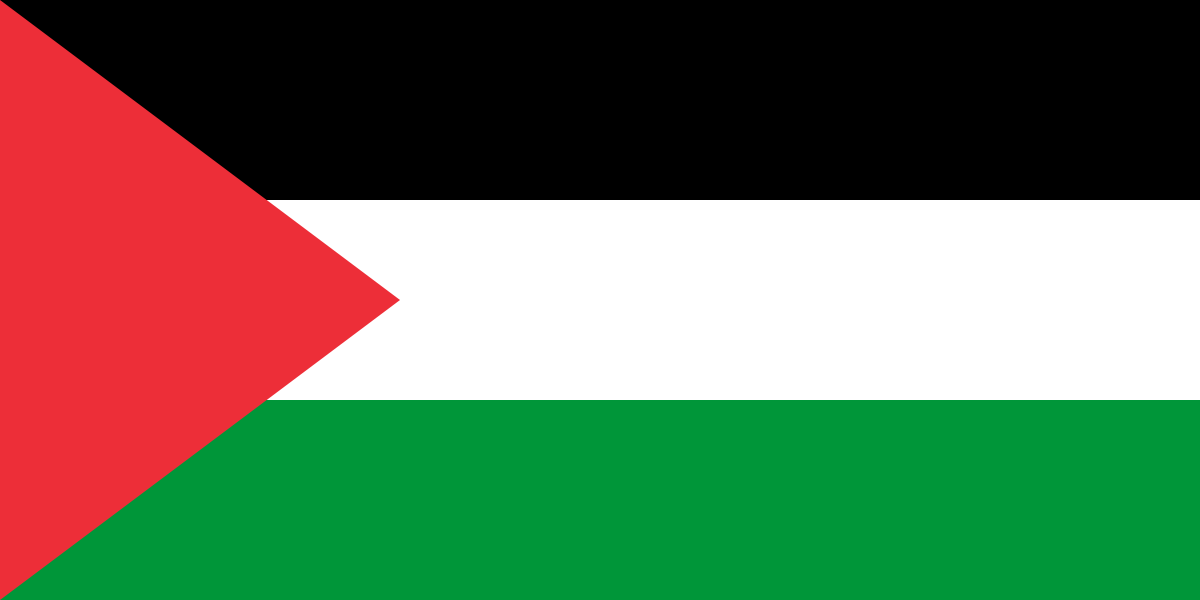
LGBTQ+ in the Palestinian Territories: The Honest Guide
Updated July 2026
Read this before anything else
This guide covers the West Bank and Gaza, and it looks nothing like our city guides, because there is nothing to list. No bars, no saunas, no cafés, no hotels that identify as gay-friendly — not in English, and, as we verified, not in Arabic-language sources either. The search comes back empty in both languages, and that emptiness is not a gap in our research. It's the accurate picture.
What we can give you instead is what actually matters here: an honest map of the risks, an explanation of how queer Palestinian life actually works, and — because it deserves telling — where that life actually happens. Spoiler: mostly not in the territories at all.
Risk level: SEVERE. And unusually, the legal fine print is the least of it.
The threat model: family first, state second
In most dangerous countries we cover, the primary threat is the state — its police, its courts, its surveillance. The Palestinian territories invert that model, and understanding the inversion is the single most important thing on this page.
Palestinian society in the territories is deeply traditional and conservative, and the taboo around homosexuality is close to absolute. The main danger to a queer Palestinian is not a statute. It's their own family and social environment. Exposure of sexual orientation or gender identity can move very fast from rumor to catastrophe: severe violence framed as defending family honor, total ostracism, or blackmail under threat of outing. The 2022 case that made international headlines — a 25-year-old gay Palestinian man beheaded in Hebron while awaiting asylum — was not state action. It didn't need to be.
The state is the second layer, not the first. But it's there, and it points the same direction. A July 2026 study by the refugee organization HIAS documented Palestinian cities distributing flyers instructing residents to report — and beat — LGBTQ individuals, and found queer Palestinians squeezed from both sides: persecuted at home, and facing mounting obstacles from Israeli authorities when they flee across the Green Line seeking safety.
Nothing about your safety plan here should assume the police are the main thing to avoid. Everyone is the main thing to avoid.
The legal picture: paper versus reality
On dry paper, the West Bank is one of the region's odd liberal exceptions. The Jordanian Penal Code — which dropped the old Ottoman-era prohibition on same-sex relations back in 1951 — still applies, meaning same-sex activity between adults is not criminalized in the West Bank. You could put that fact in a quiz and win money with it.
It means almost nothing on the ground. PA security forces use the elastic clauses that exist for exactly this purpose — "offense to public morals," "public order," appeals to religious values — to pursue, detain, and interrogate members of the community without ever needing an anti-gay statute. When the tool is vague enough, the law on the books is decoration.
Gaza is a completely different world. The British Mandate Criminal Code of 1936 remains on the books there, criminalizing same-sex acts with penalties of up to ten years — enforced under Hamas rule. But in 2026, amid an ongoing humanitarian catastrophe, the entire framework of "travel advice" collapses. Our guidance fits in one sentence: Gaza is not a travel destination for anyone, under any circumstances.
What the PA did to the community's one organization
If you want a single event that captures the official posture, it's August 2019. Al-Qaws, the Palestinian LGBTQ organization founded in 2001, held a discussion event in Nablus and announced a queer youth camp. The Palestinian police responded with a public ban on all al-Qaws activity in the West Bank — calling it harmful to the higher values and ideals of Palestinian society — and encouraged citizens to inform on participants.
International backlash followed, the statement was quietly deleted, and the PA has since preferred not to say such things where Western audiences can hear them. But the deletion changed the optics, not the reality: al-Qaws sharply curtailed its public activity in the West Bank and today works mostly through online education. The message landed and stayed landed.
About Ramallah — because everyone asks
Ramallah has a reputation as the "liberal" Palestinian city, and the reputation is half true in a way that gets people hurt when they misread it. So let's take it apart properly.
What's true: Ramallah is the administrative, economic, and cultural capital of the PA — home to dozens of international NGOs, diplomats, foreign journalists, artists, and educated young Palestinians. In the city center and districts like Al-Masyoun, there are genuinely secular, Western-leaning cafés, pubs, and cultural spaces: mixed crowds of men and women, alcohol served, modern dress, an atmosphere far more open than Nablus, Hebron, or Jenin. Young queer locals do spend time in these places — because the general tolerance for secular, modern living is higher there, and that tolerance provides cover.
What's false: the idea that any of this makes a venue gay-friendly. It doesn't, and the distinction is absolute. Even in Ramallah's most liberal bar:
- There is zero legitimacy for visible queer identity. Same-sex PDA, a rainbow anything, or open talk about orientation will get you removed, confronted, or reported — in the liberal places too. The tolerance is for secularism, not for you.
- The rumor mechanism is the enforcement. In Arabic social media, the moment a rumor circulates that a particular café has become a community meeting spot, the owners rush out emphatic public denials to clear the establishment's name. They have to. A "gay-friendly" label in the Palestinian public sphere means social boycott, attention from PA security services, or violence from conservative actors — possibly all three.
- Private apartments only. Social gatherings happen in the homes of trusted friends or foreign workers. There is no commercial space in the equation, anywhere.
- Encrypted messaging is the infrastructure. Telegram and similar apps, anonymous profiles, disappearing messages. The digital hygiene we describe in our Moscow guide applies here in full — with the added weight that the person you're hiding from may share your dinner table.
- Dating apps exist and are minefields. They're used, with extreme caution, and the local standard tells you everything: no face photos, ever. Fake profiles run as traps — for financial blackmail, for outing to family, for delivery to police — are a common, documented pattern. Verification habits that sound paranoid elsewhere (long conversations, video calls, public first meetings, a friend tracking your location) are baseline here, for locals and visitors alike.
Which is also exactly why this guide names no venues. On a site called GayOut, listing a Ramallah café is the rumor. We're not going to be the screenshot that gets someone's business burned down or someone's regular table reported. (We'll note that at least one major gay travel platform currently publishes an AI-generated "gay hotels in Ramallah" page cheerfully recommending specific nightlife spots. We think that page is reckless, and it's a good example of why machine-written travel content with affiliate links is not harm-neutral.)
Hotels: the practical answer for travelers is the same as in other high-risk places, minus any cheerfulness. Ramallah's business hotels host foreign NGO staff and journalists year-round and are professionally indifferent to guest configurations. Two travelers, twin beds, no questions. That is indifference, not welcome — never test the difference. You can compare rates on the hotel map below; book as colleagues, not as a couple.
How the community actually lives
Queer life in the territories exists. It's real, it has history, and it runs entirely below the surface:
For visitors, the rules compress to one: total discretion, with no exceptions and no "reading the room," because the room's answer is always no. Zero PDA, zero symbols, clean phone, and treat every disclosure of who you are as irreversible — because it is.
A quick word on dual identity and checkpoints. If you're visiting the West Bank as a foreign national who has also spent time in Israel, your discretion needs to be two-layered. Beyond hiding any LGBTQ+ references, remove visible Israeli identifiers — Hebrew-language apps and materials on your phone, Israeli receipts, an Israeli SIM — before entering PA-controlled areas like Ramallah or Bethlehem, and avoid speaking Hebrew entirely. At the checkpoints themselves (Qalandiya being the main Ramallah crossing), both IDF soldiers and PA police may check documents or devices: dress conservatively, keep your passport ready, and make sure your luggage carries zero political or rainbow symbols — that rule applies on both sides of the wall, for different reasons.
Where the scene actually is
Here's the part that turns this from a wall of warnings into something true and almost hopeful: queer Palestinian culture is alive. It just doesn't live at home.
The legendary Palestinian queer parties — drag shows, Arabic pop, hundreds of attendees — happen in Tel Aviv, where they moved after organizers concluded that holding them in the West Bank was impossible for fear of harassment. People travel from Ramallah, East Jerusalem, and villages across the region to reach them, each with their own ways of getting there. Haifa hosts a vibrant Palestinian queer scene of its own, with venues that have held Palestinian-Israeli drag nights. Al-Qaws continues its work from Jerusalem and Haifa. And a significant part of the community lives in exile — in Israeli cities, often in legal limbo, or further abroad in Europe.
That geography is the honest summary of this entire page: the community exists, and the territories are the one place it cannot exist openly. If you want to encounter queer Palestinian culture, you will find it — a taxi ride away from the checkpoint, on the other side.
Our policy for this region
For as long as the current conditions hold, GayOut lists no venues, events, check-in features, or user tips for the West Bank or Gaza. This is the same policy we apply to Russia, applied here for a harder reason: in Russia, a listing endangers people through the state. Here, a listing endangers the venue, its owners, and every regular in it through the community itself — and no travel site's completeness is worth that.
If conditions change, this page changes.
Sources & methodology
Everything on this page draws on documented human rights reporting, the HIAS 2026 refugee study, Palestinian and Israeli press coverage, and the public record of the 2019 al-Qaws ban — cross-checked with Arabic-language sources, where the silence itself confirmed what the reporting told us. We keep this page updated as reality shifts.
To anyone reading this from inside the territories: stay safe. You are not the only one, you were never the only one, and the community that cannot meet you at home is real, resilient, and waiting on the other side.